
Wondering what time your wedding fireworks should actually go off? It’s one of the most practical questions couples ask us, and the honest answer is that it shifts a lot depending on the time of year. A June display can’t start at the same time as a December one, because in midsummer the sky is still bright at 9pm. This guide walks you through the ideal start time for every month, based on UK sunset and twilight, so you can build your evening around it with confidence.
You don’t actually want a pitch-black sky
This is the part most couples get wrong, and it’s worth getting right, because it changes everything else.
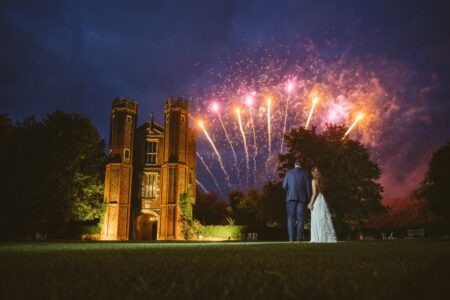
The instinct is to wait until it’s completely dark. In reality, the best-looking displays often happen a little earlier than that, in the stretch of deep blue and purple sky that photographers call the blue hour — roughly the 30 to 45 minutes after sunset, once the brightness has gone but before the sky turns flat black.
Here’s why that window beats full darkness:
- It gives the display a sense of scale. Against a black void, a firework is just a shape floating in nothing. Against a deep blue sky with a visible treeline, rooftop or horizon, your eye has something to measure it against, and a big shell suddenly looks as big as it really is.
- The colours read better. A rich blue-purple backdrop gives reds, golds and silvers something to push against. Pure black can actually swallow the softer tones.
- Your venue stays in the picture. Photographers love the blue hour because the camera still catches the building, the lawn and your guests in the foreground while the fireworks expose cleanly above. Wait for total darkness and the venue and everyone in it disappears into shadow.
- It buys you time. Starting in twilight rather than full dark gives you a little more room before the curfew, and keeps your guests from standing around in the cold waiting for “proper” night to arrive.
So when we talk about the ideal start time below, we’re aiming for that blue-hour-to-early-dark window, not the moment the last bit of light leaves the sky.
A bit of the science, quickly: sunset is just the instant the sun drops below the horizon. The sky then works through civil twilight (still fairly bright) and nautical twilight (deep blue, the sweet spot) before reaching full darkness, usually around 60 to 75 minutes after sunset. For most weddings, the back end of civil twilight into nautical twilight is the moment you want.
The one rule you can’t move: the curfew
Whatever the season, there’s a hard legal limit to plan around. In the UK it’s illegal to set off fireworks between 11pm and 7am, with four exceptions: Bonfire Night (extended to midnight on 5 November), and New Year’s Eve, Diwali and Chinese New Year (all extended to 1am). For a wedding, that means your display has to finish by 11pm — not just start before it.
That 11pm cut-off is the legal ceiling. As you’ll see further down, your venue’s own curfew is often stricter, and that’s usually the number that really shapes your timing.
Wedding fireworks start times, month by month
The table below gives recommended start windows across the year. The times are based on London / Colchester sunset data for 2026 (the two are at virtually identical latitude). These are guideline windows — your supplier will pin down the exact minute once they know your date and venue.
| Month | Sunset range | Recommended start | Notes |
| January | 16:00–16:50 | 16:45–17:30 | Earliest fireworks of the year, ideal for shorter receptions |
| February | 16:50–17:40 | 17:30–18:15 | Still early enough to fit your display before dinner |
| March (1–28) | 17:40–18:25 | 18:15–19:00 | Clocks go forward on the last Sunday of the month (29 March 2026) |
| March (29–31) | 19:30–19:35 | 20:00–20:30 | After British Summer Time begins, darkness jumps an hour later |
| April | 19:35–20:25 | 20:15–21:00 | BST means later darkness — plan the evening around it |
| May | 20:25–21:10 | 21:00–21:45 | A great month, with comfortable timing before the curfew |
| June | 21:10–21:25 | 21:45–22:30 | The latest sunsets of the year and the tightest curfew window |
| July | 20:50–21:25 | 21:30–22:15 | Still very late — build the evening around a late finale |
| August | 19:50–20:50 | 20:30–21:30 | Darkness creeps earlier as the month goes on |
| September | 18:40–19:50 | 19:15–20:30 | One of the best months for fireworks timing |
| October (1–24) | 17:50–18:40 | 18:30–19:15 | Clocks go back on the last Sunday of the month (25 October 2026) |
| October (25–31) | 16:35–16:45 | 17:15–17:30 | After BST ends, darkness returns much earlier |
| November | 15:55–16:35 | 16:30–17:10 | Very early darkness — perfect for a fireworks-led reception, even as guests arrive |
| December | 15:50–16:00 | 16:25–16:45 | The earliest darkness of the year. A display works beautifully during the drinks reception |
Sunset data based on London for 2026, sourced from SunsetTimes.co.uk. Exact times vary slightly year to year and by location.
A note on where your venue is. Those times assume a southern English venue. Latitude matters, and it works in opposite directions depending on the season. In summer, the further north you are, the later darkness falls — a Yorkshire or Scottish venue in June can be 30 to 45 minutes behind London, which makes an already tight curfew window even tighter. In winter it flips: northern venues get dark earlier than the south. Around spring and autumn the difference is small. (Western venues — Wales, Cornwall, the west of Scotland — also run a little later on the clock year-round.) If your venue is well away from the South East, tell us and we’ll work to your local sky, not London’s.
What each season looks like in practice
Spring weddings (March, April, May)
Spring is a season of transition. Early March still gives you winter-style early darkness, but by late May you’re into 21:00 starts. The clocks change on the last Sunday of March, so a wedding the weekend before goes dark a full hour earlier than one the weekend after — worth knowing if your date sits right on that line. May is a firm favourite for outdoor weddings: comfortable timing before the curfew and mild enough evenings for guests to gather outside without reaching for their coats.
Summer weddings (June, July, August)
Summer is the trickiest season for timing, simply because the UK has genuinely late sunsets. In June the sky doesn’t fully clear until gone 22:15, which is exactly where the blue hour earns its keep. Rather than waiting for total darkness and crashing into the 11pm curfew, you start in that deep blue-purple window from around 21:45 — the sky still has colour, the bursts have scale, and you’ve got room to spare before the cut-off. It’s a better-looking display and an easier one to schedule.
Because the window is tight, summer is the season we most encourage couples to book early, so the display can be slotted in from the start alongside the venue, photographer, band and caterer rather than squeezed in at the end.
Daytime options are worth a thought too. A Day Smoke display uses brightly coloured smoke that looks spectacular in full daylight, and makes a brilliant feature straight after the ceremony or during the drinks reception, completely sidestepping the late-sunset problem.
Autumn weddings (September, October, November)
Autumn is arguably the sweet spot. September hands you a beautifully timed display around 20:00 to 20:30 — proper colour in the sky, mild evenings and plenty of road before the curfew. It also lands right when most couples are doing the first dance and cake cut, so your guests are already together and the display flows straight into the photos. October brings the clock change at the end of the month, so the back half of October goes dark noticeably earlier than the first. By November you can have fireworks running from 16:30, which suits couples who’d rather the display was an early-evening centrepiece than a late finale. With darkness arriving as guests are still arriving or sitting down to eat, you get real flexibility.
Winter weddings (December, January, February)
Winter weddings have the most flexible timing of all. With sunset around 16:00 in December and early January, a display works comfortably during the drinks reception or before dinner, once that early blue hour rolls in. That opens up some lovely options: a twilight display as guests arrive for the wedding breakfast, a deep-dusk display followed by indoor effects during the first dance, or a more traditional later finale. Crisp winter air helps too — cold, clear nights give fireworks a particularly sharp, vivid look.
The factor most couples forget: your venue’s own curfew
The 11pm legal curfew is the ceiling, but it’s rarely the number that decides your timing. Many venues set their own, stricter limit — all outdoor noise to stop by 22:30, for example, sometimes earlier. In summer especially, that venue curfew can collide with the late sunset well before 11pm ever becomes relevant, which is the single most common timing squeeze we see.
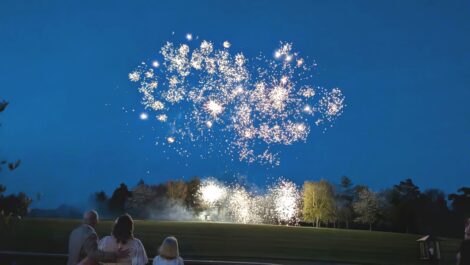
So before anything else: check your venue’s noise curfew and any restrictions on fireworks specifically. We liaise directly with venues to confirm this for you, so there are no surprises on the day. If your venue has tight sound limits, a Whisper display — full visual impact, dramatically reduced noise — is usually the answer, and we’ll design the timing around their rules.
Other things that shape the perfect time
Your reception schedule. Speeches, the wedding breakfast, the first dance and the cake cut all have to fit around the display. Most couples drop it between two moments — after the speeches but before the first dance, say, or after the cake cut as the bridge into the evening party.
Where the sunset allows it, a start somewhere between 19:45 and 20:30 tends to work beautifully, and not just for the light. That window naturally lines up with the first dance and cake cut, when your guests are already gathered in one place rather than scattered between the bar, the garden and the dance floor. It makes the display easy to call, easy to photograph and far easier to keep everyone together for the group shots straight afterwards. It’s the reason the spring shoulder months and early autumn — when darkness happens to fall right around that time — are some of our favourites to plan around.
Your photographer and videographer. The best fireworks shots happen when your suppliers know the exact start time in advance, so they can get into position and set their cameras. Tell them early — it always pays off, and the blue-hour timing above gives them far more to work with than a pitch-black sky.
Weather and cloud. Light cloud can actually lift a display, reflecting the light back down. Heavy rain or strong wind may nudge the timing, but most displays go ahead happily in light drizzle.
Layering daylight and indoor effects
If your date falls in a late-sunset month, you don’t have to rely on the outdoor display alone. Indoor cold spark effects can pick out specific moments earlier in the evening — your entrance, the cake cut, the first dance — while the outdoor fireworks land as the late finale. It’s a layered approach that works especially well for summer weddings, where the outdoor timing is necessarily late.
And where late timing simply won’t fit the schedule at all, a Day Smoke display gives you something genuinely striking in full daylight, with vivid coloured smoke that photographs beautifully in the sun.
Plan your timing with confidence
The right start time comes down to your date, your venue and the shape of your reception. Once we know those, we’ll recommend an exact window that gives you that deep blue-hour sky, comfortable timing for your guests and plenty of room before the curfew. We’ll also confirm any venue restrictions directly, so nothing’s left to chance.
Call us on 01206 699888 or email sales@dynamicweddingfireworks.co.uk for a free, no-obligation chat about your wedding fireworks. Midsummer or midwinter, we’ll help you plan a display that lands at exactly the right moment.